
















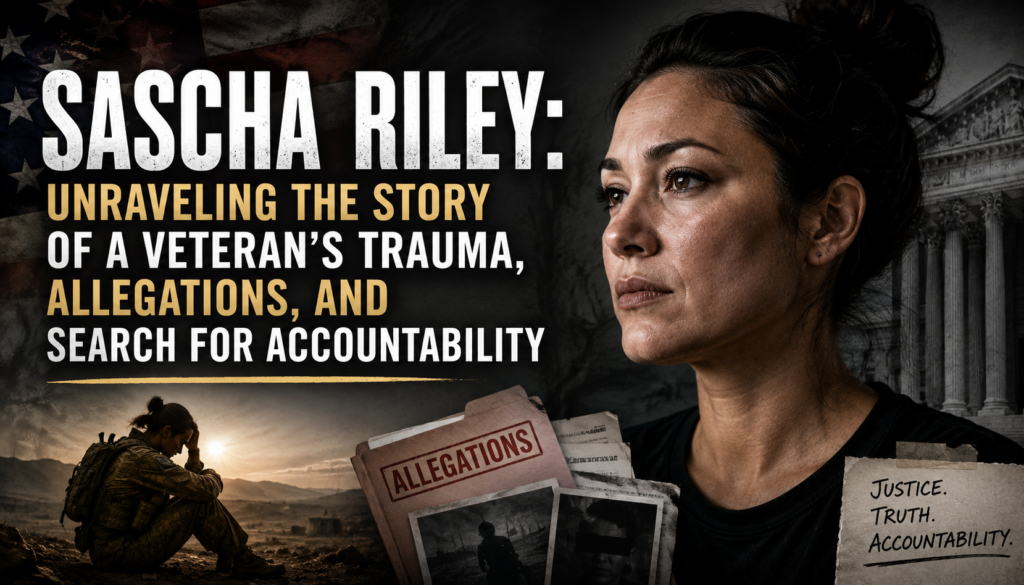
Sascha Riley, also known as William Sascha Riley or by his birth name Manuel Sascha Barros, emerged into public awareness in late 2025 as a voice recounting profound childhood trauma and alleged involvement in networks connected to Jeffrey Epstein. A decorated U.S. Army veteran with multiple tours in Iraq, Riley’s narrative blends military service, personal struggles, and detailed accusations of systemic abuse that have sparked intense online discussions, media scrutiny, and polarized opinions. His story touches on themes of repressed memories, survivor advocacy, elite accountability, and the challenges of verifying claims in the digital age.
As an Iraq War veteran who served over two decades, Riley’s life trajectory from a troubled youth to combat deployments and eventual whistleblowing offers a lens into the lasting impacts of trauma. His audio interviews, released through platforms like Substack, detail experiences that he says were unlocked years later, involving his adoptive family and powerful individuals. While supporters view him as a courageous survivor shining light on hidden networks, critics highlight the lack of corroborating evidence and fantastical elements. This article delves deeply into his background, claims, military career, public reception, and broader implications for discussions around Epstein’s legacy and institutional trust.
Early Life and Adoption of Sascha Riley
Sascha Riley’s childhood forms the foundation of his public testimony, marked by adoption and what he describes as a turbulent family environment shaped by frequent moves across the American South. Born in 1973, Riley has spoken about being adopted around age four by William Kyle Riley, a helicopter pilot and private investigator. This transition, according to Riley, exposed him to environments where exploitation allegedly thrived, including locations in Oklahoma, Tennessee, Alabama, and Texas.
The adoptive father’s profession as a pilot reportedly involved travel and connections that Riley later tied to larger operations. Riley recounts fragmented early memories solidifying into coherent recollections of parties, isolated farms, and brothels where children were allegedly present. These settings, often in rural or semi-rural areas, provided a backdrop for claims of systematic abuse that spanned several years during the 1980s. Riley emphasizes how the mobility of his family, driven by his adoptive father’s work, isolated him from stable support systems, making documentation or intervention difficult at the time.
Growing up in this context, Riley describes a pattern of control and manipulation that extended beyond immediate family. He mentions specific details like overheard conversations, travel logistics, and interactions with adults in positions of authority. These accounts paint a picture of a young boy navigating fear, confusion, and survival instincts in environments where power imbalances were stark. The adoption itself, while providing a new family structure, allegedly introduced vulnerabilities that Riley connects to broader trafficking dynamics prevalent in discussions of Epstein associates. Family dynamics, including relationships with stepsiblings and a stepmother, added layers of complexity to his formative years.
Riley’s early experiences also intersect with regional histories of child welfare challenges in the South during that era. Movements between states complicated any potential oversight from authorities, a factor he highlights when discussing the absence of early records. His narrative underscores how socioeconomic and geographic factors can shield illicit activities, a theme resonant in modern analyses of child protection failures. Through detailed retellings in interviews, Riley provides timelines, place names, and sensory recollections that supporters argue demonstrate consistency, even if independent verification remains elusive.
Military Service and the Making of an Iraq War Veteran
Sascha Riley’s entry into the U.S. Army marked a pivotal shift from adolescence to disciplined service. As a teenager facing legal troubles in Alabama, including a fistfight that led to a court choice between jail and military enlistment, Riley opted for the latter. He initially served around seven years at Fort Bragg, North Carolina, in the 1990s, honing skills in a high-pressure environment before transitioning to civilian work like welding in Arizona.
Post-9/11, Riley rejoined the Army, embarking on three tours in Iraq. His service record reflects the commitment of many veterans from that period, involving intense combat operations, leadership responsibilities, and the physical and psychological toll of prolonged deployments. Rising to the rank of Sergeant First Class, Riley’s military journey included instances of being “blown up,” contributing to long-term health challenges. His DD-214 discharge form confirms significant active duty, lending credibility to his veteran status amid public skepticism.
During and after service, Riley dealt with post-traumatic stress disorder (PTSD), a common reality for Iraq War veterans. He has described combat as involving “impossible decisions” with lifelong repercussions, attributing broader responsibility to political leadership that initiated the conflicts. This perspective aligns with many veterans’ reflections on the Iraq War’s human cost, including moral injuries and reintegration difficulties. Riley’s marriage during this period, to a woman met in Oklahoma, and the birth of children added personal stakes to his service.
The discipline and resilience forged in the military later influenced Riley’s approach to sharing his story. Veterans often face unique barriers to discussing trauma, and Riley’s decision to go public echoes the advocacy of others seeking recognition for hidden wounds. His service in units like those at Fort Sill, Oklahoma, connected him back to regions tied to his childhood claims, creating a full-circle element in his biography. Supporters point to his decorated status as evidence of character, while others note how military experiences might intersect with memory processing in complex ways.
Repressed Memories and the Unlocking Process

One of the most discussed aspects of Sascha Riley’s account involves the emergence of repressed or recovered memories around 2020. Riley explains spending extended periods in isolation, listening to music and reflecting, which facilitated the solidification of previously inaccessible recollections. This process, he links to dissociative identity disorder (DID) or similar trauma responses, conditions recognized in psychological literature as potential outcomes of severe childhood abuse.
The unlocking unfolded gradually, with fragments evolving into detailed narratives. Riley describes how wartime PTSD and life stressors may have acted as catalysts, allowing buried experiences to surface. Critics question the reliability of such memories, citing psychological debates on false memory syndrome, while proponents reference studies on trauma dissociation and delayed recall in survivors. Riley’s consistency across multiple interview sessions forms a key pillar of his credibility for believers.
This phase coincided with personal upheavals, including separation and divorce from his wife, who has publicly expressed differing views on the nature of these memories. Riley’s family life, including time with his children, was impacted, highlighting the ripple effects of trauma disclosure. The process involved extensive self-research into Epstein-related materials, politics, and historical contexts, which Riley says helped contextualize his experiences. This introspective journey reflects broader societal conversations about memory, therapy, and validation for adult survivors of childhood abuse.
Allegations Involving Jeffrey Epstein and Networks
Central to Sascha Riley’s testimony are claims linking his adoptive father to Jeffrey Epstein’s operations. Riley alleges that William Kyle Riley, as a pilot, facilitated transport and participated in activities connected to Epstein’s network during the 1980s. These assertions place Riley as a child witness to events involving powerful figures, with Epstein positioned within a larger enterprise.
Details include specific flights, locations, and interactions that Riley says he observed or endured. Epstein’s documented history of sex trafficking and elite connections provides a framework that some use to evaluate Riley’s claims, though direct ties to Riley’s adoptive family lack independent public confirmation. Riley’s accounts extend to the production of materials allegedly distributed within these circles, touching on disturbing themes of exploitation that echo verified Epstein victim testimonies.
The timing aligns with Epstein’s early activities, raising questions about the evolution of such networks. Riley’s narrative contributes to ongoing public interest in Epstein files and unredacted documents, fueling demands for transparency. Discussions around Riley often reference how Epstein’s web allegedly extended into political and financial spheres, with Riley positioning himself as one survivor among many whose stories remain fragmented.
Connections to Donald Trump and Political Figures
Riley’s allegations specifically name Donald Trump as an individual involved in abusive incidents during his childhood. These claims, detailed in audio interviews, describe encounters at events or locations where Trump allegedly participated. Riley ties these to the 1980s, a period when Trump was a prominent New York figure with known Epstein associations.
Additional politicians, including Jim Jordan and Andy Biggs, appear in Riley’s accounts as attendees or participants at gatherings. These assertions have drawn significant attention due to the individuals’ current prominence. Riley provides contextual details like ages, settings, and behaviors to support his recollections. Public reactions range from calls for investigation to outright dismissal based on timelines and lack of contemporaneous evidence.
The political dimension amplifies Riley’s story within partisan divides. Supporters see it as exposing hypocrisy in elite circles, while detractors frame it within “BlueAnon” conspiracy narratives. Riley maintains these details emerged independently of political motivations, rooted in personal memory recovery. This intersection of trauma testimony and politics underscores challenges in separating fact from narrative in high-stakes public discourse.
The Audio Interviews and Public Release

The release of over four hours of audio interviews conducted by Lisa Noelle Voldeng in 2025 marked a turning point for Sascha Riley’s visibility. These unedited conversations capture Riley recounting experiences with emotional depth, including graphic descriptions of abuse, witnessed violence, and survival mechanisms. The interviews gained traction on platforms like YouTube, Substack, and social media, amassing views and discussions.
Voldeng’s approach, presenting herself as an advocate for victims, facilitated Riley’s comfort in sharing. The tapes include timelines, place references, and potential leads for verification, such as police reports or CPS records. Listeners note Riley’s consistency and emotional authenticity, though professional fact-checkers emphasize the need for external corroboration. The raw format contributes to their impact, allowing audiences to engage directly with the testimony.
Distribution through independent channels bypassed traditional media gatekeepers, reflecting shifts in information dissemination. The interviews sparked podcasts, summaries, and community analyses, with some creators performing fact-checking against public records. This body of material remains a primary source for understanding Riley’s perspective.
Military Records, Verification Efforts, and Skepticism
Sascha Riley’s military documentation provides verifiable anchors in his biography. Service records confirm his enlistments, deployments, rank, and discharge, offering a factual baseline. Researchers and journalists have cross-referenced these with public databases, affirming his veteran status.
However, childhood allegations face greater scrutiny. Efforts to locate supporting records in Oklahoma, Texas, Alabama, and Tennessee have yielded limited results, with authorities citing confidentiality. Riley’s adoptive father has denied key claims, and timeline discrepancies noted by investigators fuel skepticism. Psychological experts debate recovered memories, while some point to Riley’s self-diagnosis of DID as potentially influenced by online communities.
Independent analyses, including by outlets like Snopes and MS NOW, highlight the absence of concrete evidence beyond testimony. Riley and supporters argue that systemic cover-ups explain gaps, a common assertion in Epstein-related discussions. This tension between personal account and evidentiary standards defines much of the public debate.
Impact on Family, Personal Life, and Relationships
Riley’s disclosures profoundly affected his personal relationships. His ex-wife, Pearleen Riley, has described the memories as delusions that strained their marriage and family dynamics, leading to separation in 2021 and divorce. The couple’s children, born during Riley’s later service years, experienced disruptions, with Riley no longer in regular contact.
Financial struggles, including bankruptcy after a trucking business venture, compounded challenges during civilian reintegration. Riley’s move to places like Victoria, British Columbia, for respite reflects efforts to find peace amid controversy. Family members, including his adoptive father, have pushed back publicly, creating rifts that underscore the personal cost of coming forward.
These experiences mirror those of many trauma survivors, where disclosure tests bonds and invites isolation. Riley’s story illustrates the intersection of veteran reintegration, mental health, and advocacy.
Media Coverage and Online Virality
Mainstream and independent media have covered Sascha Riley’s story variably. Outlets like MS NOW and Substack journalists have profiled him, balancing survivor empathy with evidentiary caution. Social media platforms amplified the audio files, with figures like Rosie O’Donnell encouraging engagement.
Virality stems from alignment with Epstein interest and political tensions. Podcasts, Reddit threads, and X discussions dissect details, with communities forming around belief or debunking. This ecosystem demonstrates how digital tools empower marginalized voices but also spread unverified claims rapidly.
Coverage often frames Riley within larger survivor movements, prompting reflections on media responsibility in handling sensitive testimonies.
Psychological Aspects of Trauma and Recovery
Riley’s account engages with complex psychology, including PTSD from war and childhood, memory repression, and potential DID. Trauma specialists note that severe abuse can lead to dissociation as a coping mechanism, with recall triggered later in life. Riley’s therapeutic journey and self-reflection highlight recovery paths available to veterans and survivors.
Challenges include societal stigma around recovered memories and mental health disclosures. Riley’s emphasis on music and solitude as aids offers insights into non-traditional healing. Broader implications touch on support systems for veterans dealing with compounded traumas.
Legal and Investigative Ramifications
Riley has reportedly contacted authorities, including the FBI and Oklahoma agencies, with varying responses. Calls for investigations into his leads persist, though outcomes remain unclear due to confidentiality. Legal experts discuss barriers like statutes of limitations and evidentiary hurdles in historical abuse cases.
The story fuels advocacy for Epstein file transparency and victim protections. Potential civil or criminal avenues depend on corroboration, underscoring systemic issues in prosecuting elite-involved crimes.
Cultural and Social Significance in the Epstein Conversation
Sascha Riley’s emergence adds to the Epstein canon, keeping public focus on accountability. It intersects with #MeToo extensions, veteran advocacy, and anti-trafficking efforts. Discussions question power structures that enable exploitation across decades.
Riley symbolizes resilience for some and cautionary complexity for others. His story encourages critical examination of narratives while honoring survivor voices.
Challenges Faced by Survivors in High-Profile Cases
High-profile allegations bring intense scrutiny, doxxing risks, and credibility attacks. Riley’s experience exemplifies these, alongside platform amplification. Support networks and ethical journalism play crucial roles in navigating such landscapes.
The Role of Veterans in Advocacy and Truth-Telling
Veterans like Riley bring unique credibility and discipline to advocacy. Their service often informs perspectives on justice and institutional failures. Riley’s path highlights how military backgrounds can fuel post-service missions for accountability.
Public Reactions, Supporters, and Critics
Reactions span belief, empathy, skepticism, and hostility. Supporters emphasize lived experience and consistency; critics demand proof. This divide mirrors broader societal polarization on truth and testimony.
Broader Implications for Child Protection and Elite Accountability
Riley’s narrative spotlights vulnerabilities in adoption, travel industries, and elite networks. It calls for stronger safeguards, better record-keeping, and independent oversight to prevent recurrence.
Featured Snippet Opportunity: Sascha Riley is an Iraq War veteran who alleges childhood sex trafficking by his adoptive father linked to Jeffrey Epstein’s network, involving claims against Donald Trump and others. His story, shared via 2025 audio interviews, remains largely uncorroborated but has ignited widespread debate on survivor credibility and institutional transparency.
Comparison Table: Verified Facts vs. Allegations in Sascha Riley’s Story
| Aspect | Verified/Confirmed Elements | Alleged/Unverified Elements |
|---|---|---|
| Military Service | Multiple Iraq tours, SFC rank, DD-214 records | Specific connections to childhood events |
| Childhood Adoption | Adopted by William Kyle Riley | Details of trafficking operations |
| Personal Life | Marriage, children, bankruptcy, divorce | Repressed memory timelines and specifics |
| Public Claims | Audio interviews released 2025 | Direct involvement of named political figures |
| Investigations | Contacts with FBI/OSBI; limited public outcomes | Existence of snuff films, specific murders |
Conclusion
Sascha Riley’s journey—from Iraq War veteran to public figure sharing profound allegations—encapsulates resilience amid unresolved pain and societal divisions. Whether viewed as a key witness to hidden truths or a complex case study in memory and narrative, his story compels deeper examination of power, protection, and justice. As discussions around Epstein and survivor voices evolve, Riley’s contributions fuel essential conversations on accountability and healing. Continued rigorous inquiry, empathy for trauma survivors, and commitment to verifiable facts will shape how such stories influence future understanding and reform. The full truth may require more time and evidence to emerge, but the dialogue Riley sparked underscores humanity’s ongoing pursuit of light in dark corners.
FAQ
Who is Sascha Riley?
Sascha Riley is a U.S. Army veteran with service in Iraq, known for 2025 audio interviews detailing alleged childhood abuse and trafficking connections to Jeffrey Epstein’s network.
What are Sascha Riley’s main allegations?
Riley claims he was trafficked as a child by his adoptive father, involving high-profile individuals including Donald Trump, at various Southern U.S. locations in the 1980s.
Is there evidence supporting Sascha Riley’s claims?
While his military records are confirmed, the childhood allegations largely rely on his testimony. Independent investigations have not publicly corroborated the specific abuse claims.
How did Sascha Riley’s story become public?
Through a series of audio interviews released on Substack in late 2025, which spread rapidly online.
What is Sascha Riley’s military background?
He served approximately 21 years, including three Iraq tours, retiring as a Sergeant First Class after deployments from bases like Fort Bragg and Fort Sill.
Why do some people believe Sascha Riley?
Supporters cite emotional consistency in interviews, alignment with Epstein patterns, and his veteran credibility.
Why is Sascha Riley’s story controversial?
Critics point to unverifiable details, timeline issues, family denials, and potential psychological factors influencing memory.
What has been the media response to Sascha Riley?
Coverage ranges from empathetic survivor profiles to skeptical fact-checks, with significant independent and social media amplification.
Has Sascha Riley faced legal repercussions?
No major lawsuits or charges directly tied to his disclosures have been widely reported as of mid-2026, though family and public pushback exists.
What can be learned from Sascha Riley’s experience?
It emphasizes the importance of trauma-informed support, transparent investigations, and careful navigation of public testimony in the digital era.